


Purchase Our Products

Resources
Humanoid Robot Cooling with Green-Laser Copper LPBF
Category:Case Study
Area:humanoid robot thermal management; humanoid robot cooling; green laser copper LPBF; robot liquid cooling; 3D printed copper cold plate; joint actuator cooling; AM thermal management
Release time:2026-08-28
Last update:2026-09-04
Designing Thermal Management for
Humanoid Robots
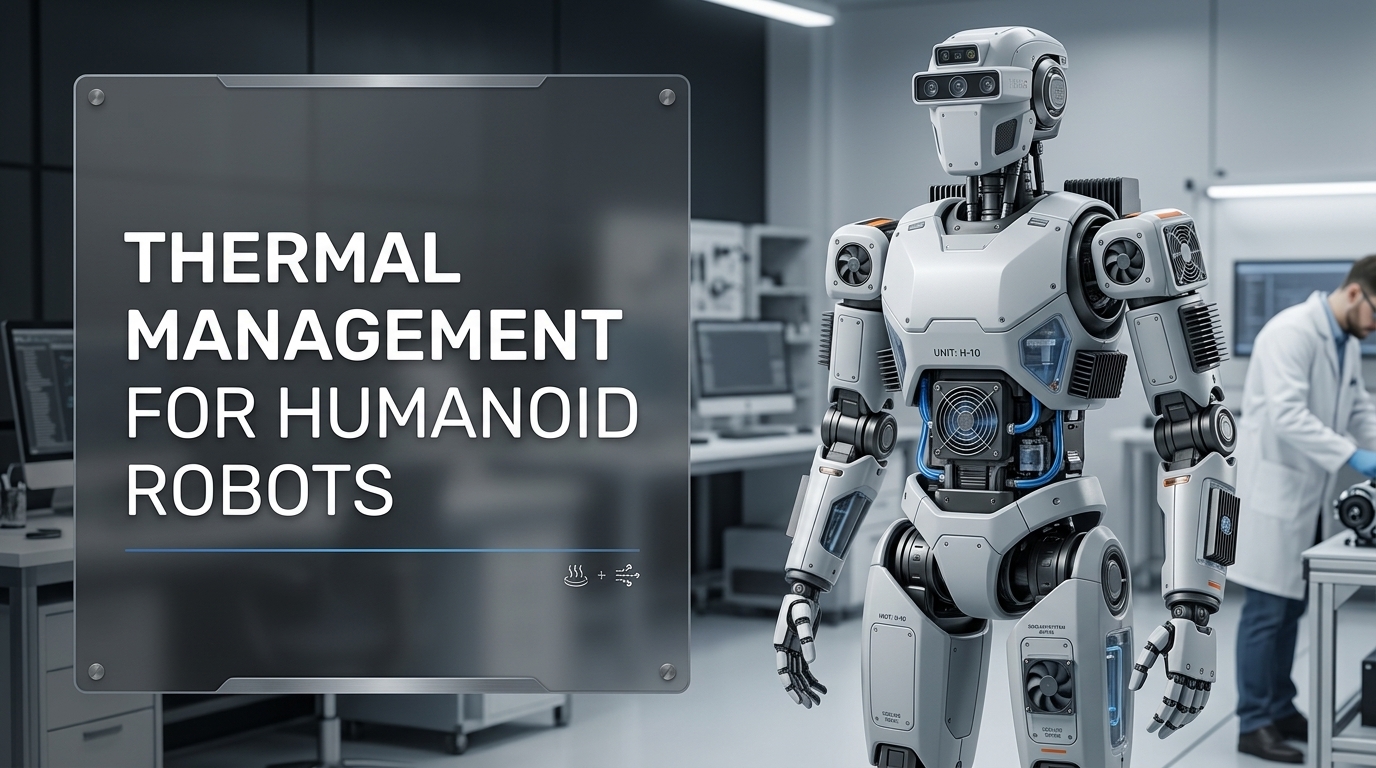
Heat in a humanoid robot is spread across moving, tightly packaged subsystems. Joint actuators, drive electronics, on-board computing and the battery do not share the same load profile, but they compete for the same limited space. Thermal management therefore has to be considered at system level, alongside structure, motion and control.
No single cooling method fits every robot subsystem. Passive solutions remain practical for modest or intermittent loads. Liquid cooling becomes relevant when heat flux, operating time or packaging limits exceed what air-side cooling can manage. Green-laser LPBF is a manufacturing route for selected copper parts—not a default solution for every cold plate.
Where the heat comes from
Joint modules combine motors, reducers, bearings and drive electronics in a small moving envelope. Compute modules place processors, memory and power conversion close to sensors and communication hardware. Battery packs add another temperature-sensitive subsystem whose performance depends on both peak temperature and temperature uniformity.
During long duty cycles, these sources can raise local temperatures faster than the surrounding structure can reject heat. The result may be torque or clock-frequency derating, protective shutdowns, faster ageing of insulation and cells, or changes in lubricant behaviour. The cooling path must also avoid cables, sensors, structural load paths and service interfaces.
Cooling hardware has five practical requirements
A robot cooling component is rarely judged on thermal performance alone. It must fit the available envelope, limit moving mass, carry mechanical loads, follow curved or irregular surfaces and remain reliable under repeated operation.
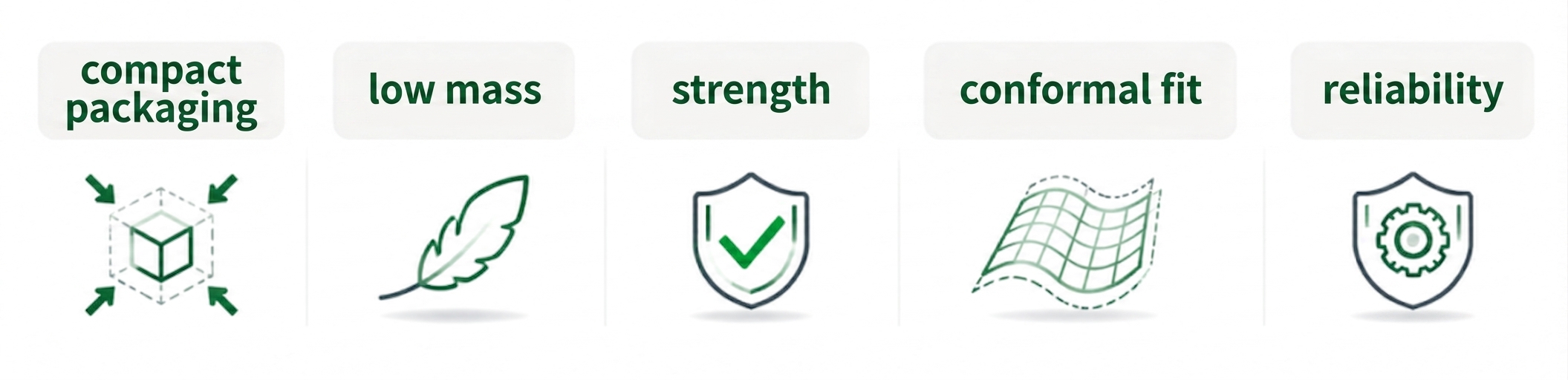
Figure 1. Typical design requirements for robot cooling hardware: compact packaging, low mass, strength, conformal fit and reliability.
Select the cooling method by load and duty cycle
Most robots use a combination of cooling methods. The decision should reflect heat load, duty cycle, orientation, noise, contamination risk, mass and maintenance—not a general preference for one technology.
Method | Typical use | What it does well | Primary constraint |
Passive conduction and natural convection | Low-power or intermittent subsystems | Simple, quiet and free of moving parts | Heat rejection is limited by area, orientation and ambient airflow |
Forced air | Controllers and ventilated enclosures | Established, serviceable and relatively low cost | Requires fans and duct space; adds noise, dust exposure and fan-life risk |
Heat pipe or vapour chamber | Moving heat from a local hot spot to a remote sink | Provides high effective conductance without a pump | Integration depends on geometry, wick design, orientation and joining |
Liquid cooling | High heat flux, long duty cycles and tight packaging | Moves heat out of a confined region and can improve temperature uniformity | Adds pressure drop, pumps, seals, coolant control and leak testing |
Liquid cooling: better heat removal, tighter engineering controls
Placing coolant close to a hot component can shorten the thermal path, but the cold plate becomes a pressure-containing flow part. Channel geometry has to balance heat-transfer area, flow distribution and pressure drop. Walls must be thin enough to limit conduction resistance and strong enough for pressure, vibration, machining and handling.
For one-dimensional conduction, Rcond = t/(kA), where t is the conduction length, k is thermal conductivity and A is area. A shorter path and a higher-conductivity material reduce this term, but total thermal resistance also includes interfaces and convection. Pump power, coolant temperature and flow maldistribution must be evaluated separately.
Why use a green laser for pure copper?
Pure copper is widely used for heat spreading because bulk material has a room-temperature thermal conductivity of about 400 W/(m·K). It is difficult to process with the near-infrared lasers commonly used in metal LPBF because the material reflects much of the incident energy at those wavelengths.
At green wavelengths, typically 532 nm, copper couples more readily with the laser. This can provide a more usable process window for pure-copper LPBF. Absorptivity is not a fixed percentage: it changes with powder packing, temperature, melt-pool state and surface condition. Density, conductivity and feature quality still depend on the complete parameter set and post-processing route.
Three robot subsystems to evaluate
1. Joint actuators and motor-drive modules
A conformal jacket can route coolant around a motor, stator region or drive enclosure without forcing the joint into a flat cold-plate geometry. Integrated distribution passages may reduce fittings and external tubing. The design must still account for moving mass, structural load paths, electrical isolation and service access. Copper is appropriate only when the thermal benefit justifies its weight.
2. On-board AI compute modules
Processors and power electronics can create concentrated heat loads near sensors and communication hardware. A copper cold plate can spread heat and shorten the path to the coolant while fitting small passages into a thin section. Contact flatness, interface material, inlet temperature, allowable pressure drop and leak detection remain part of the design.
3. Battery and power-management hardware
Battery systems usually need controlled temperature distribution rather than maximum local heat removal. Printed cold plates or manifolds can route flow around cells, busbars and structural features, but material selection must also cover mass, corrosion, galvanic compatibility and electrical isolation. Aluminium or a hybrid solution may be more suitable than pure copper in weight-sensitive assemblies.
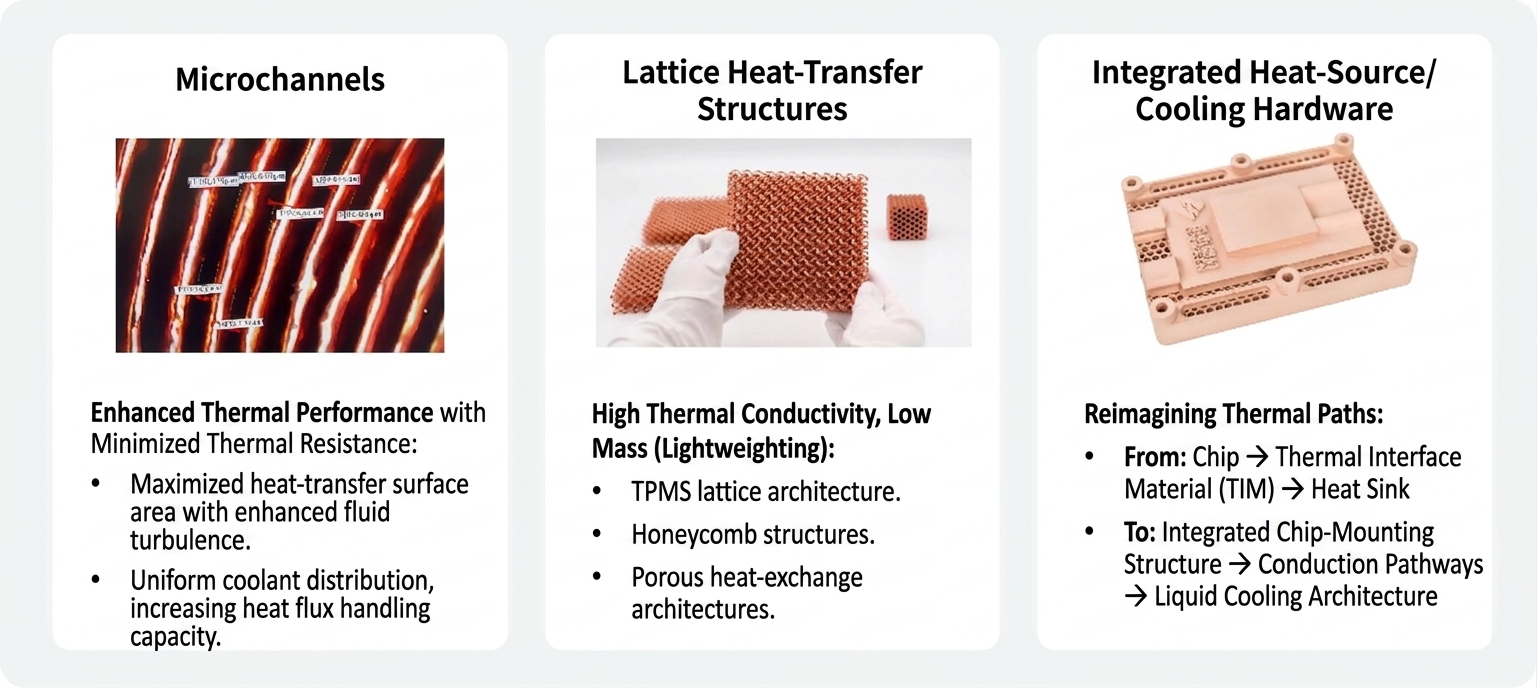
Figure 2. Three AM-enabled design routes: microchannels, lattice heat-transfer structures and integrated heat-source/cooling hardware.
Manufacturing and verification belong in the same plan
A functional cooling component normally requires printing, support removal and project-specific post-processing. Depending on the design, this may include stress relief, CNC finishing of sealing or mounting faces, deburring, internal cleaning and surface treatment.
Quality assurance should be matched to the failure modes. Dimensional inspection verifies external interfaces; CT can examine selected hidden features; flow and pressure-drop tests check hydraulic behaviour; proof-pressure and leak tests address containment; and thermal testing confirms the complete heat path under defined boundary conditions. Not every project needs every test, but the sequence and acceptance limits should be agreed before production.
Conclusion
Thermal management for humanoid robots is a system-design task. Passive cooling, forced air and heat pipes remain appropriate when load and packaging allow them. Liquid cooling is more relevant at higher heat flux or longer duty cycles, but it brings hydraulic, sealing and inspection requirements.
Green-laser copper LPBF makes sense when a compact part needs conformal channels, integrated manifolds or a short heat path that is difficult to produce by established methods. Selection should begin with the thermal and fluid requirements, then move to material choice, manufacturability, production volume and verification.
Looking for 3D Printing Services?
For on-demand manufacturing, part production, and instant quotes, please visit our dedicated Service Bureau platform by clicking the button to the right.
Printing Service
Unlock Green Laser Metal AM: Your Partner for Equipment & Services
Business Cooperation & Equipment Inquiries
Interested in acquiring our Green Laser AM systems or exploring partnership opportunities? Please fill out the form below, and our sales team will contact you shortly.
I confirm that I accept the Privacy Policy.



Subscribe
Sign up for product updates and promotions!
I agree to receive industry news, product and service promotions, and all other relevant Addireen communications.


Contact Us
Shenzhen Addireen Technologies Co., Ltd.
Building 7, Detai Technology Park, Dalang Street, Longhua District, Shenzhen, Guangdong, China.
(+86) 193-5719-8013
Copyright © 2026 Addireen. All Rights Reserved | 粤ICP备2024303078号-1